Big big earthquake with magnitude 6.6 happened at 16.05.41 WIB, The epicenter is located at 7.01° South Latitude and 105.26° East Longitude precisely at sea at a distance of 52 km to the southwest of the Banten Well with a depth of 10 km. Based on observations made by paying attention to the location of the epicenter and the depth of the hypocenter, The earthquake that occurred was a type of shallow earthquake due to subduction activity. The results of the analysis of the source mechanism show that the earthquake has an upward movement mechanism (thrust fault).
Due to the enormous shaking, caused some damage and loss in several places. The impact of the earthquake occurred in 48 districts, 166 village or village. The worst affected areas include Sumur . District, Cikeusik, Cimanggu in Pandeglang and Lebak Regencies.
Based on the latest reported data, there are as many 3.078 broken house, with details 395 heavily damaged unit, 692 moderately damaged unit, and 1.991 Slightly damaged unit. This earthquake also caused 51 school building units, 17 health facility unit (health facility), 8 government office unit, 3 business unit, and 21 places of worship are also damaged. As a result of the disaster, The Pandeglang Regent stipulates an emergency response status for 14 day, counted from date 14 until 27 January 2022.
Disaster events often raise various kinds of problems, start with economic problems, social welfare to gender-based violence. Gender shapes vulnerability and resilience to disasters in diverse and complex ways.
Referring to the purpose of the Sendai framework, namely Prevent new and reduce existing disaster risk through the implementation of integrated and inclusive economics, structural, legal, social, health, cultural, educational, environmental, technological, political and institutional measures that prevent and reduce hazard exposure and vulnerability to disaster, increase preparedness for response and recovery, and thus strengthen resilience. In line with the goals mandated by the Sendai framework, it is important to reduce disaster risk by increasing the capacity of the community.
SDGs are 13.3 which sings "Improving education", awareness growth, and human and institutional capacities related to mitigation, adaptation, impact reduction and early warning of climate change”.
One of the themes in the GPDRR is “leave no one behind” investing locally and empowering the most at risk. To be able to realize the leave no one behind theme, we need to transfer knowledge and knowledge about threats and also disaster preparedness in the region.. Building resilience of vulnerable groups requires various sectors to cope with disaster events. The role of local community involvement by involving various local/village level stakeholders, the involvement of women and other gender representatives is needed to produce joint solutions in development after a disaster occurs. In the process of reconstruction after the disaster, there is an opportunity to 'build back better', ensure PRB, endurance, and community input designed for rebuilding.
The cultural and social context of a disaster is important, and post-disaster situations can lead to rapid social and material changes. Social networks are critical to their livelihood strategies, and their mental health and resilience. Reducing isolation is the key to unlocking the power that can be found in collective action. Temuan Tan-Mullins et al, shows that poor management of material assistance is urgently needed, sometimes it can unavoidably damage the cohesion of the community and the social fabric of this community in the long term by eroding trust in this community. Resilience development strategies in post-disaster contexts must be made with reference to specific local socio-economic contexts if they are to be sustainable, effective and well understood. Resilience building strategies are rarely linear and often context dependent.
Indonesian Scale Foundation Research (2020) argued that development planning that does not involve gender representation creates various gender problems. The different needs of each gender make the facilities built also have to be adapted to reduce vulnerability. Women can become one of the potentials in disaster risk reduction if their potential is recognized and involved in decision making and also the implementation of disaster management programs.
The participatory and bottom-up approach led by the affected communities holds great promise that the post-disaster recovery process will be better able to meet their needs. Empowerment of women in the post-disaster context is necessary considering that disasters expose and exacerbate existing social exclusion in society. Opportunities for dialogue and communication can provide space for community, women and other gender groups to connect and encourage those around them, and build social capital. From there, communities can build their relationships with others and find common goals. Knowledge, agency, and women's collective action must be fully recognized and supported to build resilience, reduce disaster risk, and contribute to sustainable development.
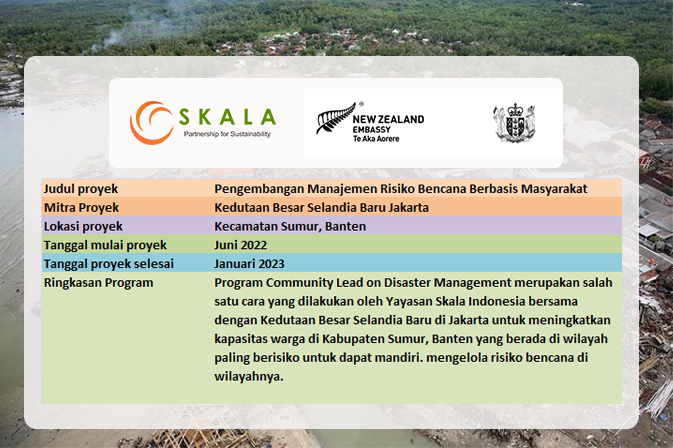
Therefore, The Indonesian Scale Foundation together with the New Zealand embassy in Jakarta initiated the Community Lead on Disaster Management program as a way to increase the capacity of residents in the most at-risk areas to be able to independently manage disaster risks in their area..
This activity aims to promote and educate gender-sensitive and inclusive local leadership for disaster risk reduction, increase community capacity in dealing with local capacity-based disasters, increase community capacity in managing community-led risk itself, build disaster preparedness practices that are inclusive and mainstream to gender and vulnerable groups, open collaboration between institutions at the village level, open access to village funds and other sources including local resources, increasing the role of women in disaster risk reduction efforts in 4 village, Well District.
The output of this activity is a Village-Based Disaster Risk study, Village-Based Disaster Management plan, and a Village-Based Earthquake Contingency plan with the achievement of outcome indicators, namely that gender groups can understand disasters and disaster risk management by organizing disaster management activities that actively involve women in every process., establishment of the Village Disaster Preparedness Group, there are barns that can be managed in an emergency, there is a network with institutions around the village for disaster risk reduction. (DM)